Opera
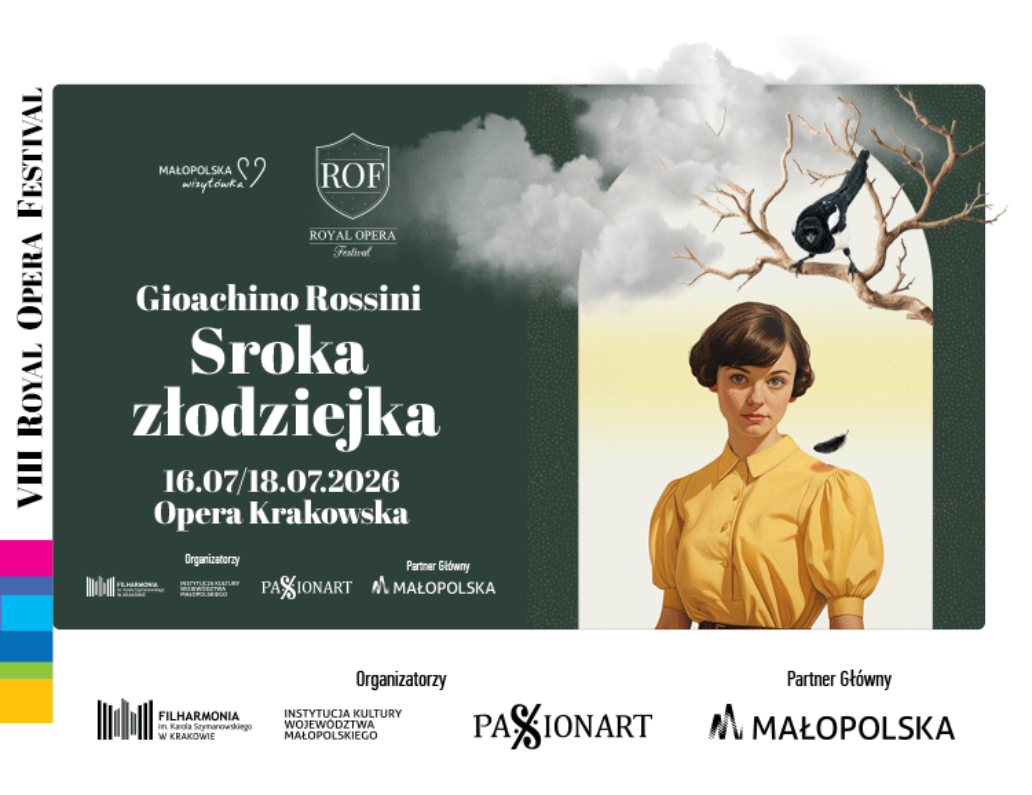
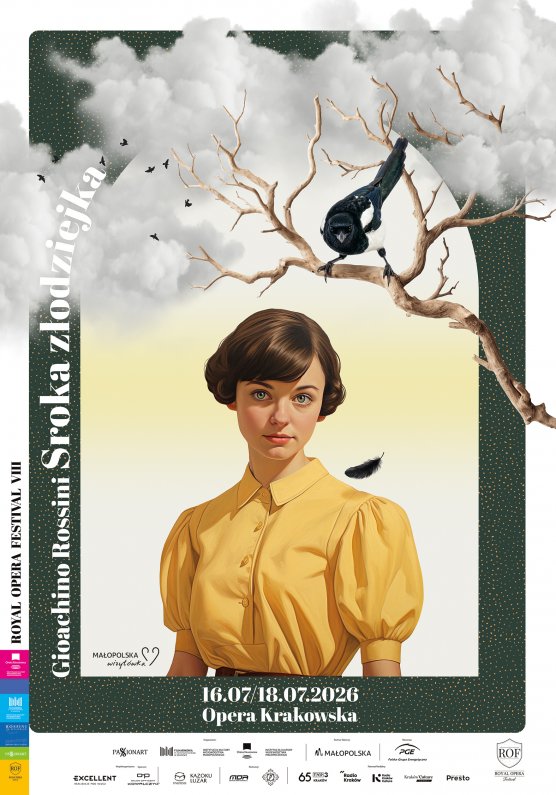
La gazza ladra
Gioachino Rossini
José Miguel Pérez-Sierra
3
hours
20
minutes
details
information
duration
3
hours
20
minutes
|
1
intermission
composer
Gioachino Rossini
libretto
Giovanni Gherardini
World premiere
May 31st 1817, Teatro alla Scala, Milan
language
original Italian version with Polish subtitles
description
The Eurasian magpie is the protagonist of many folk tales and superstitions. Among the myths associated with it, the most prominent one is that it is a kleptomaniac that steals jewelry and keeps bringing shiny objects back to its nest. There is no scientific evidence for this, although in the 18th century a story was popular about a young maid from the town of Palaiseau near Paris who was sentenced to death for stealing silverware. The stolen goods were found in a magpie’s nest after the sentence had already been carried out.
A theme of a thieving magpie appeared in G. Rossini’s semiseria opera La gazza ladra (The Thieving Magpie). The libretto was penned by G. Gherardini, who wrote it for F. Paër; it was not until a year later that the unused text found its way into Rossini’s hands.
Gherardini based his work on a drama inspired by the story of a maid from Palaiseau, written by L. Ch. Caigniez and T. B. d’Aubigny. The librettist changed the ending to a happy one (in his version, the maid survives) and also incorporated several comedic scenes. Rossini spent nearly three months working on the music. He began in March, and by the end of May 1817, the opera premiered to great acclaim at La Scala in Milan.
The Thieving Magpie took the stages of Europe’s finest theaters by storm (it was also staged in Poland in 1825, 1830, and 1833). In Warsaw, Rossini’s work was admired by, among others, a teenage F. Chopin, who later incorporated the melody from one of the arias into one of his polonaises. In the mid-1960s, The Thieving Magpie was shown in Florence and London, and later during subsequent editions of the Pesaro Festival. Thanks to its masterful blend of elements from opera seria and opera buffa, brilliant ensemble scenes, superb characterization, and a spirited overture, the work has secured its place in the history of opera.
------------------
author of the text: Dorota Staszkiewicz
A theme of a thieving magpie appeared in G. Rossini’s semiseria opera La gazza ladra (The Thieving Magpie). The libretto was penned by G. Gherardini, who wrote it for F. Paër; it was not until a year later that the unused text found its way into Rossini’s hands.
Gherardini based his work on a drama inspired by the story of a maid from Palaiseau, written by L. Ch. Caigniez and T. B. d’Aubigny. The librettist changed the ending to a happy one (in his version, the maid survives) and also incorporated several comedic scenes. Rossini spent nearly three months working on the music. He began in March, and by the end of May 1817, the opera premiered to great acclaim at La Scala in Milan.
The Thieving Magpie took the stages of Europe’s finest theaters by storm (it was also staged in Poland in 1825, 1830, and 1833). In Warsaw, Rossini’s work was admired by, among others, a teenage F. Chopin, who later incorporated the melody from one of the arias into one of his polonaises. In the mid-1960s, The Thieving Magpie was shown in Florence and London, and later during subsequent editions of the Pesaro Festival. Thanks to its masterful blend of elements from opera seria and opera buffa, brilliant ensemble scenes, superb characterization, and a spirited overture, the work has secured its place in the history of opera.
------------------
author of the text: Dorota Staszkiewicz
Poster
producers and cast
producers
music director | José Miguel Pérez-Sierra
director | Jochen Schönleber
set designer | Jochen Schönleber, Lars Warneke
costume designer | Izabella Firek
lighting director | Michał Piosek
Choir preparation | Agnieszka Ignaszewska-Magiera
assistant director | Eleonora Calabro, Romeo Gasparini
asistant music director | Andrés Jesús Gallucci
stage manager | Justyna Jarocka-Lejzak
tłumaczenie | Joanna Jachimek
director | Jochen Schönleber
set designer | Jochen Schönleber, Lars Warneke
costume designer | Izabella Firek
lighting director | Michał Piosek
Choir preparation | Agnieszka Ignaszewska-Magiera
assistant director | Eleonora Calabro, Romeo Gasparini
asistant music director | Andrés Jesús Gallucci
stage manager | Justyna Jarocka-Lejzak
tłumaczenie | Joanna Jachimek
cast
Giannetto | Patrick Kabongo
Ninetta | Claudia Muschio
Pippo | Francesca Di Sauro
Podesta | Nathanaël Tavernier
Fernando | Emmanuel Franco
Fabrizio | Matteo Torcaso
Lucia | Gaja Vittoria Pellizzari
Isacco/Pretore | Davide Zaccherini
Antonio | Timoteo Bene
Ernesto/Giorgio | Giovanni Accardi
Orchestra and Choir of The Karol Szymanowski Philharmonic in Kraków
José Miguel Pérez-Sierra | conductor
Andrés Jesús Gallucci | pianoforte
--------------------
IMPORTANT INFORMATION
The performance features:
♦ scenes of violence
♦ loud and unpredictable sound effects
♦ smoke effects
♦ recommended for audiences aged 16 and up
Ninetta | Claudia Muschio
Pippo | Francesca Di Sauro
Podesta | Nathanaël Tavernier
Fernando | Emmanuel Franco
Fabrizio | Matteo Torcaso
Lucia | Gaja Vittoria Pellizzari
Isacco/Pretore | Davide Zaccherini
Antonio | Timoteo Bene
Ernesto/Giorgio | Giovanni Accardi
Orchestra and Choir of The Karol Szymanowski Philharmonic in Kraków
José Miguel Pérez-Sierra | conductor
Andrés Jesús Gallucci | pianoforte
--------------------
IMPORTANT INFORMATION
The performance features:
♦ scenes of violence
♦ loud and unpredictable sound effects
♦ smoke effects
♦ recommended for audiences aged 16 and up





upcoming performances of this genre
/